
The Ultimate Guide to World Radio: Stream Every Country Live
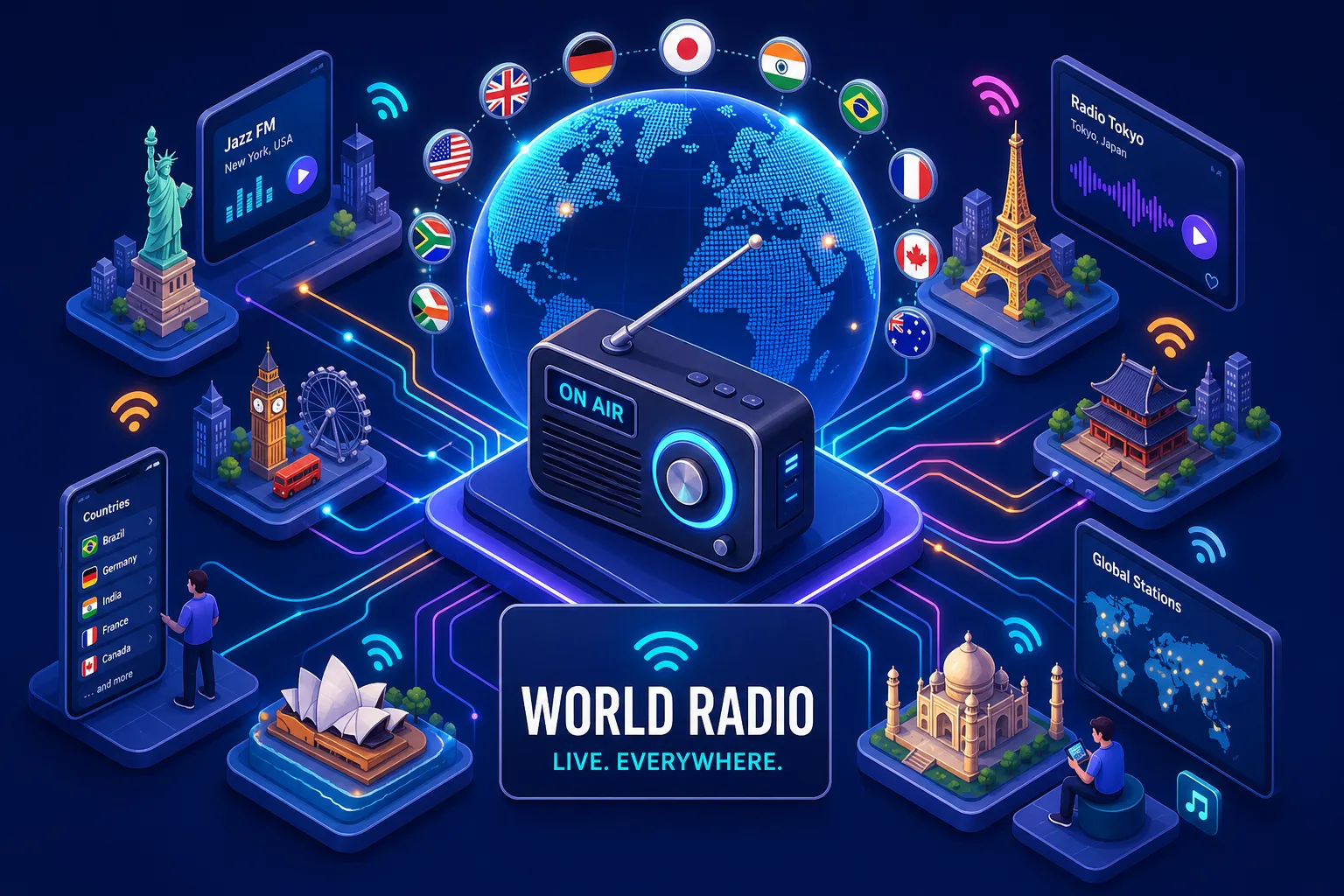
Picture this: it's 11 p.m. on a Tuesday, and you're streaming a cumbia station broadcasting live from Medellín. No app download, no subscription, no antenna pointed at the sky. Five minutes later, you pivot to the BBC World Service rolling out of London, crystal clear in your browser tab. That's the reality of world radio in 2026: live audio from tens of thousands of stations worldwide, available in a browser tab with a single click.
Global radio streaming means exactly what it sounds like: live audio broadcasts from stations across every continent, accessible through any modern browser on any device. The stations are real, the broadcasts are happening right now, and the library stretches into the tens of thousands: platforms like TuneIn index over 100,000 stations, while radio.net catalogs 60,000-plus. SpinRadio maps those stations onto a rotating 3D globe so you can literally spin your way to a new culture, but we'll get to that shortly.
By the time you finish this guide, you'll know how internet radio reaches your browser, which platforms are worth your time, how to start listening in under a minute, and where to dig for the rare and archival broadcasts that most listeners never find.
What world radio actually is (and why it hooks people in)
International broadcasting didn't start with the internet. Governments, religious organizations, and community broadcasters were transmitting across continents via shortwave frequencies as early as the 1920s. The BBC launched its World Service in 1932. Voice of America began in 1942. Radio Moscow was beaming programming to North America through the Cold War. Those same institutions, and thousands of smaller local stations that followed them, now stream online, often running live in parallel with their traditional FM or AM frequencies.
World radio is not a single service or a centralized directory. It's an ecosystem of 60,000 to 100,000 independent stations (depending on how you count them), each broadcasting in its own language, format, and cultural context. A community radio station in Dakar operates completely independently from a Top 40 pop station in Seoul or a classical music broadcaster in Vienna. The variety is staggering, and that's exactly the point.
The motivations behind listening are just as varied as the stations themselves. Music explorers chase sounds they can't find on algorithm-driven playlists. Expats tune in to hear sports commentary or news in their native language. Language learners use live radio as an immersive alternative to structured study. Radio hobbyists who once spent weekends turning a shortwave dial have migrated their passion to the browser. What all of these listeners share is the same draw: audio curated by a human programmer for a real local audience, not assembled by a recommendation engine based on your listening history.
The hardware barrier that once defined shortwave listening — the receivers, the antenna setups, the patience required to coax a signal through atmospheric noise — collapsed with the rise of browser audio. Today, the same global reach that required a dedicated radio setup in 1985 is available in a browser tab with a single click. That shift opened international radio to an entirely new generation of listeners who never owned a shortwave receiver.
How world radio streaming reaches your browser
Three delivery formats carry most of what you hear when you stream a live station: HLS, Icecast, and Shoutcast. Understanding them in plain terms helps you troubleshoot when a stream misbehaves and appreciate why browser-based listening works as reliably as it does now.
HLS vs. Icecast vs. Shoutcast: what's the difference?
HLS (HTTP Live Streaming, identified by .m3u8 URLs) breaks audio into small chunks that load progressively over standard HTTPS. This makes it stable even on slower connections, since the player can buffer ahead without holding a single continuous connection open. Icecast and Shoutcast work differently: they're server software that push a continuous MP3 or AAC stream directly to your browser over a steady TCP connection. Icecast and Shoutcast deliver lower latency (roughly 2 to 5 seconds), while standard HLS can lag 15 to 30 seconds behind the live broadcast. For news and talk radio where timeliness matters, ICY streams are preferable. For music, the latency gap is rarely noticeable in practice. For a practical breakdown of these delivery methods, see this comparison of Shoutcast vs Icecast vs HLS.
The signal path from a station to your ears follows a straightforward route: the station's audio hits an encoder, gets packaged into a stream format, is pushed to a server, and your browser pulls it on demand. Live streams are real-time only — if the station goes off air, the stream stops. Many broadcasters supplement their live feed with on-demand archives or podcasts, but the stream itself carries no rolling buffer you can rewind. That real-time quality is part of what makes live international radio feel genuinely distinct from on-demand platforms. It's worth noting that HLS playback is native in Safari, while other browsers typically handle .m3u8 streams through JavaScript players or the browser's media stack, so behavior can vary slightly depending on your browser of choice.
Before the Web Audio API matured, streaming a radio station in a browser required Flash or a dedicated desktop client. Those days are gone. Today, you can go from a cold browser tab to streaming a jazz station out of Tokyo in under ten seconds. That frictionless access is the technical foundation on which browser-native platforms like SpinRadio are built. If you'd like a deeper look at how independent services are rethinking live streams, check out the piece on Independent Radio Live Stream that explains the engineering and discovery choices behind modern browser-native radio.
The best world radio platforms for discovery
SpinRadio offers one of the most visually immersive ways to browse and stream live international radio in a browser. The core experience is a 3D globe covered in clickable station beacons positioned at each station's actual broadcast location. You spin and zoom to any country, click a beacon, and audio starts immediately — no account, no signup, no paywall. The platform streams FM, AM, Icecast, Shoutcast, and HLS formats, and it runs on a lightweight custom canvas engine designed to load quickly across a wide range of devices, read more about why SpinRadio is your go-to online radio station app.
A real-time trending layer surfaces which stations are drawing the most listeners globally at any given moment, giving you a live pulse of what people around the world are actually tuning into. The experience is ad-free across desktop and mobile browsers, which is a meaningful difference from most alternatives in this space.
Other platforms serve different needs. Radio Garden popularized the globe interface and hosts a large station library across 220 countries, though UK users face restrictions on international content due to licensing agreements, and full ad-free access sits behind a premium tier. TuneIn is the most comprehensive directory by raw numbers, indexing over 100,000 stations, and works well if you know exactly what you're searching for. radio.net offers a searchable index of 60,000-plus stations with a clean text-based interface for listeners who prefer search over exploration. These are solid tools for finding specific stations, but they function primarily as directories rather than discovery experiences.
The distinction between a great platform and a basic directory comes down to one question: does the platform help you find something you didn't know to look for? A list of stream URLs serves the listener who already knows what they want. A visual, interactive globe with a live trending layer serves the listener who wants to be surprised. That's a meaningful product difference, not a cosmetic one.
How to start listening to any country's radio right now
On desktop, the fastest path to your first international stream takes about fifteen seconds. Open SpinRadio in Chrome, Firefox, Safari, or Edge. JavaScript needs to be enabled for the interactive globe to function, but that's the default browser setting, so no adjustment is needed for most users. Spin the globe to a region you're curious about, click any station beacon, and the stream starts. No registration step, no email address, no paywall between you and the audio.
On mobile, SpinRadio runs in your phone's browser without requiring an app download. Some mobile browsers prompt for audio playback permission on first use, behavior varies by browser and operating system, but granting that permission is typically the only extra step. Once you do, playback controls can appear on your lock screen via the MediaSession API, which gives the experience the feel of a native app without the installation. Audio streaming is also lightweight on data compared to video, so it runs comfortably on standard mobile connections.
When a stream won't load, the cause is usually one of three things: the station is off air (some broadcast only during local daytime hours), the stream URL has changed, or the station's content is geoblocked in your region due to music licensing restrictions. If you hit a dead stream, try a different station in the same country. On SpinRadio's globe, the trending layer helps you identify currently active stations, since stations drawing live listeners are visibly active on the map in real time.
Beyond the mainstream: finding rare and archival international broadcasts
Listeners interested in historical international broadcasting have two primary resources worth knowing. The Shortwave Radio Audio Archive (SRAA) hosts off-air recordings going back to 1934, including broadcasts from Cold War-era stations, numbers stations, and transmissions from Antarctic outposts, all available as a podcast and through direct streaming on their site, a useful reference is the Shortwave Radio Audio Archive (SRAA) coverage. The Internet Archive's Digital Library of Amateur Radio and Communications (DLARC) holds program schedules, artifacts, and recordings from stations like Radio Baghdad and Radio Kiev, donated from private collections and preserved as a historical record of international broadcasting before the internet era.
For live niche station discovery, the most effective approach is geography-first browsing rather than genre search. Spin to a region you're curious about and follow the sound. SpinRadio's trending map frequently surfaces world radio stations online that you'd be unlikely to find through a standard algorithm, because the trending data reflects what real human listeners are actually tuning into globally, not what a recommendation engine predicts you might enjoy. For listeners who want the raw signal experience closer to traditional shortwave, WebSDR and KiwiSDR let you tune into live shortwave and amateur frequencies through a browser interface without any hardware required.
Why live world radio beats algorithm-driven listening
There's something that happens when you land on a station you didn't search for: a genre you didn't know existed, a language that sounds beautiful even without comprehension, a local sports broadcast from a city you've never visited. That kind of accidental discovery can't be engineered by a recommendation algorithm. It depends on a human programmer in Bogotá or Nairobi or Reykjavik making decisions for a local audience with no knowledge of your listening profile. The content is chosen for someone else, and that's exactly what makes it interesting to you.
Anyone who's spent time on algorithm-heavy platforms knows the feeling: an increasingly narrow corridor of "because you liked" suggestions, interrupted by audio ads, until the whole experience starts to feel like a loop. Live international radio on a platform like SpinRadio operates entirely outside that system. No account means no listening history. No listening history means no recommendation bubble. No ads means the audio doesn't stop for a commercial break. The content is live, human-programmed, and comes from somewhere in the world that has nothing to do with your previous listening behavior.
Start exploring world radio today
Live international radio is one of the few genuinely open corners of the audio internet. The concept has been around since the shortwave era, but browser-based streaming has removed every barrier that once kept casual listeners out. Whether you're chasing music from a specific country, using a foreign station for language practice, reconnecting with broadcasts from home, or simply curious what people in Lagos are listening to on a Friday afternoon, the gateway is a single browser tab away.
SpinRadio is a direct entry point for all of it: spin the globe, click a beacon, and you're listening in under ten seconds with no account, no ads, and no friction. Open it up, pick a region you've never listened to before, and let the stream run for twenty minutes. Start exploring world radio, spin the globe and listen now. The odds are strong that you'll find something worth coming back to. For ongoing coverage and updates on global audio and radio technology, visit the SpinRadio Blog.
Frequently Asked Questions
How can I listen to live radio from other countries?
You can stream live radio from other countries using browser-native apps like SpinRadio.app, which maps thousands of live global streams onto an interactive 3D globe, letting you listen to foreign stations with a single click.
What are HLS, Icecast, and Shoutcast in radio streaming?
These are audio streaming delivery formats. HLS (HTTP Live Streaming) breaks audio into small chunks for stable playback, while Icecast and Shoutcast push a continuous low-latency stream (around 2-5 seconds delay) directly to your browser.